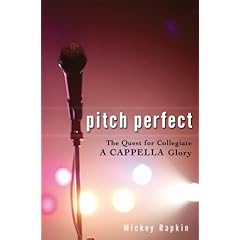
 It’s hard enough to pull off a book about music. (Wouldn’t radio or film be a better choice?) And then to go and choose a cappella — sounds like certain disaster.
 But writer Mickey Rapkin discovered just the opposite. In his book Pitch Perfect: The Quest for Collegiate A Cappella Glory, Rapkin proves that the world of competitive a cappella is rich with fascinating factoids and entertaining, albeit gossipy, stories. It’s anything but the snooze fest one might imagine from a story about a musical genre where even the harmonica is forbidden.
Writing from the informed perspective of a former insider (Rapkin’s an alumnus of the all-male singing club at Cornell), the a cappella veteran pokes fun at this dorky yet lovable subculture while also offering plenty of evidence as to why these kids should be taken at least half as seriously as they take themselves. Rapkin, senior editor at GQ, has ferreted out and woven in such jaw-dropping details as the fact that some groups net $30,000 a year from shows and record sales. Top-tier groups are hired to sing at Disneyland or even travel abroad for gigs. As additional proof, Rapkin outs other now-famous former undergrad a cappella-ites like John Legend, Anne Hathaway, Art Garfunkel, and Diane Sawyer. Even Osama bin Laden sang in an a cappella ensemble.
Throughout Pitch Perfect, Rapkin incorporates the history of a capella, tracing it from its religious roots through to its recent revolution. Breaking almost completely from traditional barbershop, a cappella today favors the arena of rockin’ pop hits. The cover songs they produce sound nearly indistinguishable from the originals, making you ask, “Did they really manage to sing that guitar solo?” Rapkin answers all those how-the-heck questions, providing ongoing mini music lessons on what it takes to transform a multi-instrument composition into an all-vocal arrangement. The reader can almost hear the imitation snare drum and a bass, as Rapkin describes it: sh-sh-k-ts-sh-sh-k-ts.
But the book is about much more than music. Rapkin chronicled the seasons of three collegiate a capella powerhouses, which all happen to be at a crossroads. The University of Oregon’s red-hot, all-female group Divisi is about to compete for the first time after being robbed of the 2005 international championship title. Tufts University’s Beelzebubs, legendary in a cappella circles, are back in the studio stressing over how to produce an album that will stand up to their last — the CD that redefined contemporary a cappella. And finally the rowdy, frat-boyish Hullabahoos of the University of Virginia are trying to figure out how to get serious without losing their signature cool.
Along the way, Rapkin introduces readers to a handful of singers from each group, but opts for breadth over depth. Most of the people in Pitch Perfect are sketched lightly — Rapkin makes the real characters the groups as a whole. As each chapter progresses, we become embroiled in each ensemble’s plight, its inner politics and inside jokes.
Pitch Perfect is like the a cappella culture’s Best In Show, but sweeter and more heart-breaking. The only missing piece is the soundtrack.
--
Book Details: Pitch Perfect: The Quest for Collegiate A Cappella Glory
By Mickey Rapkin 275 pp. Gotham Books, 2008 $26.00
Rapkin also maintains an entertaining blog on all things a capella that's worth checking out.

And you simply must take a listen to Divisi. They've posted a number of their songs online. I have their latest CD Roots and highly recommend it.
This review was published this month in Etude. Visit Etude for more reviews of new narrative nonfiction, including books by Tony Horowitz and Mary Roach.


