This past November I was invited to speak at the NonfictionNow Conference at the University of Iowa. The topic was journalism versus creative nonfiction and whether or not to include the self. My background is in traditional daily journalism (NO Me), but my best piece of writing is probably my story about egg donation which was written in first-person (No, ME).
Here are the thoughts I shared that day:
How many of you self-identify as journalists?
How many of you identify as creative nonfiction writers?
How many of you aren’t sure where you fall?
Some definitions might help --- sometimes I feel like we can’t talk to each other because we don’t know what the other means when they say creative nonfiction vs. literary journalism.
CREATIVE NONFICTION IS …
"'Creative nonfiction' precisely describes what the form is all about. The word 'creative' refers simply to the use of literary craft in presenting nonfiction—that is, factually accurate prose about real people and events—in a compelling, vivid manner. To put it another way, creative nonfiction writers do not make things up; they make ideas and information that already exist more interesting… using literary techniques like scene, dialogue, and description, while allowing the personal point of view and voice rather than maintaining the sham of objectivity." -Lee Gutkind, the godfather of creative nonfiction.
LITERARY JOURNALISM IS …
“a form of storytelling as old as the telling of stories. The genre recognizes both the inherent power of the real and the deep resonance of the literary. It is a form that allows a writer both to narrate facts and to search for truth, blending the empirical eye of the reporter with the moral vision -- the I -- of the novelist.” -Lauren Kessler, narrative nonfiction author and director of the graduate program in literary nonfiction journalism at the University of Oregon.
To me, these definitions sound more similar than distinct. To be honest, I think what we do as literary nonfiction journalists and creative nonfiction writers is essentially the same.
I don’t think one is more powerful, or more valid, or more worthy.
A thoroughly researched, thoughtfully written memoir has the potential to be better work of a journalism than a third-person nonfiction book that is sloppily written and poorly researched … And vice versa.
It doesn’t have to be one or the other. The categorization, in my opinion, has more to do with how the writer prefers to be identified or what shelf her work going to sit on in Barnes & Noble or how it’s being sold to a general audience --- and that general audience really doesn’t care about the nit-picky details of whether it’s called literary nonfiction. Creative nonfiction. Factual fiction.
What people care about is whether it’s TRUE. As a reader, I just don’t want to be lied to. I don’t want to be told that I’m reading a factual story and find out later that the author has intentionally twisted the truth or omitted relevant details. As long as you’re honest with what you are doing ---- if it’s written from memory that can’t be substantiated, fine. If you’re approximating the dialogue/scenes, OK. Just say so. I just want things to be true to the best of the writer's knowledge, that the writer hasn’t made things up purposefully.
But people do make things up in both creative nonfiction and journalism. There are lots of notorious cases. When it’s intentionally fictionalized and you’re trying to pass it off as nonfiction, it’s just wrong.
What bothers me about journalists is that we stand with our chests puffed out and say we just deal in cold hard facts and telling the truth. We dismiss any further discussion on how much actual truth comes out of what we do.
I didn’t contemplate this in any significant way until I liberated myself from the old school rules of journalism and wrote my first, first-person piece. As I was writing, I came to a point where I had to explain my motivations – and I thought to myself, why did I do that?
I wrote the first idea that came to my head. But it felt off. I tried on another explanation but that didn’t ring true either. I realized I couldn’t explain my actions. It took weeks of contemplation until I’d written myself into a place where I finally understood my true motivation.
And then it dawned on me how ridiculous is it that I’ve been conducting interviews for years asking questions like, “What motivated you to do X?” And I’d give the subject all of 30 seconds to respond.
As writers, we spend a lot of time in our heads. We reflect. We mull. We question ourselves (incessantly at times).
The average person doesn’t dig that deeply into the psyche.
So when we as journalists ask a person “Why did you do that?” We may be asking her to think in a way that she rarely thinks. And while the answer may not be intentionally false, it may not be entirely true either.
--
Because I find writing about other people more interesting than writing about myself, I returned to the No Me camp. It wasn’t easy though. I had the nagging feeling that what I was doing as a journalist was fraught because it seemed impossible to gather much less tell the complete truth.
But that doesn’t mean that I’m going to stop trying to tell true stories.
Because we live in a culture where we are inundated with facts and soundbytes that are often devoid of insight, we need creative nonfiction / literary journalism whatever the heck you want to call it, to give context to information and human experience.
We need this type of storytelling (Me, or No Me) because it helps us all make sense of the world.
Showing posts with label narrative nonfiction. Show all posts
Showing posts with label narrative nonfiction. Show all posts


Nov 7, 2008
Q&A with narrative writer and humorist Beth Lisick
 Beth Lisick wears about a billion hats. She's a poet, essayist, short fiction and narrative nonfiction writer. She also a humorist and spoken word artist, who does freelance voice work and even some acting. This New York Times bestselling author also moonlights as a giant banana that hands out fruit on the street. No kidding. This woman is worth getting to know.
After reading her latest book about her adventures in the self-help business, Helping Me Help Myself: One Skeptic, 10 Self-Help Gurus, and a Year on the Brink of the Comfort Zone, I interviewed Lisick and, I have to say, the result of the Q&A session is one of the funniest we've done at Etude.
So take a read below and get to know Ms. Lisick and what she has to say about being a storyteller. You won't be disappointed.
Q: You majored in American Studies at UC Santa Cruz and once aspired to be a pastry chef — how did you learn how to tell stories and write?
A: My last couple years in college, while I was working as a baker, I started writing things down in notebooks. Mostly overheard conversations or childhood memories, nothing even remotely resembling a poem or story. That part seemed too daunting, the act of writing something “real.” It wasn’t until after I was out of college and stumbled upon an open mic that I really got serious about trying to write things. I liked the immediacy of that scene, the fact that you could write something and test out whether it was working or not. Still, what I was writing was only intended for people to hear, not to read on a page. When the publisher from Manic D Press asked to see my manuscript of spoken word poems and stories, I didn’t want to give her what I’d written. I was embarrassed. What was I doing? Once she talked me down, helped me out, and put out that collection (Monkey Girl), I began writing with a reader, not just a listener, in mind.
As far as telling stories goes, I have always been a superfan of listening to other people’s stories. The ham gene is definitely in me, the one that makes me like to get up on stage and tell stories, but I also have a good dose of the observer. I had two best friends growing up and we would always try to tell each other good stories, even if it was just about going to Costco with our parents or trying to reenact something that happened at a school dance. I love thinking about how you sequence events to maximize hilarity or drama. You know, do you reveal what your dad said about the enormous can of frank and beans before or after you’ve described the stockboy’s hairdo? That kind of stuff.
Q: Besides being a writer, you are also a spoken word artist and a humorist. Being funny on paper isn’t easy — the humor often doesn’t translate. How have you developed this skill and how do you know when it’s working?
A: I like to write conversationally and I’m always thinking about whether what I’m writing is going to translate to a spoken performance or not. So I’ll read stuff out loud to myself to see how it sounds. A lot of it is trial and error. Sometimes I write something for a book and I just know that I will never read that section out loud at an event. Conversely, I write things to read out loud that I would never publish. You can do a lot in performance, using your voice and body language, to make up for mediocre writing. Hurray for that! The trick is learning how to distinguish between what you publish and what you read to a crowded bar. Sometimes a piece of writing can be both, but I am still learning.
Q: For your latest book, Helping Me Help Myself, you dedicated yourself (in 2006) to a year-long experiment in self-improvement, devoting each month of that year to an area you wanted to work on (e.g. fitness, organization, spirituality, personal finances, etc.) What were the easiest and most difficult months of the experiment to write about?
A: The absolute easiest was the home organization chapter. I wanted so much to improve that area of my life that I was pretty dedicated to following the advice of the expert. Just about every other chapter felt difficult. Even the Richard Simmons cruise where all I had to do to be entertaining was describe what was happening and throw in some of Richard’s direct quotes. He’s so intriguing. I really struggled with that book because there is so much to make fun of in the self-help world, but I didn’t want to go with the easy laughs all the time. It was a constant battle, juggling the sarcasm and irony and honesty. Also, the chapters on sex and fashion completely evaporated because I could not bring myself to do them. I’m pretty complacent with both of those areas of my life — not that I’m a sex machine with a killer wardrobe — but it just seem disingenuous to dedicate entire chapters to things that I ultimately wasn’t that unhappy with.
Q: Of all the self-help advice you consumed two years ago, what has stuck with you most?
A: Probably the idea from The Seven Habits of Highly Effective People that you need to determine what your life purpose is. I always thought that kind of thing was unbearably cheesy, that it messed with my laidback m.o., but it started to make a lot of sense. Once I defined my main creative purpose as storytelling — and I did this just by thinking about what makes me really happy and excited — I felt more focused and inspired. I could better see that my life isn’t the random and chaotic mess I sometimes perceive it to be. Not that I have become a streamlined machine. I’m just a little more confident about what I do. And it’s still hard to write this stuff without cringing.
In the chapter on personal finance, we learn that making a living as a writer isn’t easy — even for a New York Times bestselling author. What advice do you have for other writers when it comes to money?
Don’t expect too much and then you’ll be happy when it comes! I love talking about money because it’s such an uncomfortable subject. People often email me about that chapter, surprised that I could be so strapped for cash when my books are seen as being pretty successful. I think I make about as much money a year as a public school teacher, which I’m proud of, though I do a lot of other things besides write to earn it (and while I’m at it, if anyone in charge of anything is reading this, schoolteachers should be paid more.) I emcee events, run a storytelling series, teach writing to high schoolers, dress up in a banana costume, judge writing contests. I got a hundred and fifty bucks last week to have dinner with some marketing people for Levi’s and talk about What Women Want. Plus I got some free jeans. And then there’s the fact that I live in the Bay Area, which is an expensive place to be, and my husband is a self-employed musician and recording engineer, so neither of us have a job with health benefits. We pay a ton for private insurance. When I say that I will pretty much do anything for a hundred bucks, I mean it. I don’t think my money issues are very different from regular middle class people, but if you get your picture in a magazine, people sometimes think you also must have a hot tub and a cleaning person and no credit card debt. Very few writers get rich doing it, so you have to make sure you love to write. But you can make a living. Don’t listen to people who tell you that you can’t.
For the complete interview, visit Etude's new fall edition.
Nov 4, 2008
The Obama Ground Game - A narrative

In honor of Election Day, I'm posting an excerpt from a recently published narrative piece that gives a ground-level view of the inside of the Obama campaign. The writer, Nancy Webber, has been on the trail for Obama since January, campaigning in Oregon, California, New Mexico, Texas and Colorado.
After you vote, take a break from CNN and check out Nancy Webber's story. It's well worth the read.
For the entire piece, visit Etude, the journal of literary nonfiction.
January 13, San Francisco
A week later, I walk into Obama's San Francisco headquarters during a precinct captains’ meeting. The organizer asks, “Who is volunteering on a campaign for the very first time?” More than 80 percent of the people raise a hand. These people don't know it yet, but some of them will form lifelong friendships because of this campaign. As I listen to the organizer prepare this new group of volunteers for what she wants them to do, I'm struck by her approach. She doesn't jump right into the instructions, she asks them why they are here. It's standard procedure on the Obama campaign to ask, because it prepares canvassers for a different way of reaching voters.
“He was right when a lot of people were wrong, including myself, about the war,” said a Naval Academy graduate and veteran of the first Gulf War. The vet thought he probably had more in common with McCain, but that Obama had the potential to make real change.
“It’s personal," said Ben Muhammed. "My son had five job interviews with no call backs. He came and asked me if he could change his name to something other than Muhammad. We talked about it and I finally agreed to see if it made any difference. He changed his last name, sent the same resume to the same institutions, and he got three different offers.”
Each volunteer in turn speaks and the bond is formed. The work of contacting voters isn't easy, but they have learned that their job is not to persuade others to believe in Obama, but to persuade voters to believe in themselves — that their concerns are valid and that they can be agents of change. After today, this group will be back many times. They now owe it to each other. ...
Aug 5, 2008
Reviewing Mickey Rapkin's book Pitch Perfect
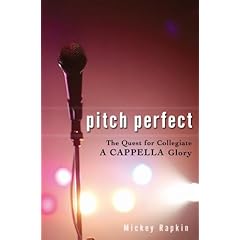 It’s hard enough to pull off a book about music. (Wouldn’t radio or film be a better choice?) And then to go and choose a cappella — sounds like certain disaster.
But writer Mickey Rapkin discovered just the opposite. In his book Pitch Perfect: The Quest for Collegiate A Cappella Glory, Rapkin proves that the world of competitive a cappella is rich with fascinating factoids and entertaining, albeit gossipy, stories. It’s anything but the snooze fest one might imagine from a story about a musical genre where even the harmonica is forbidden.
Writing from the informed perspective of a former insider (Rapkin’s an alumnus of the all-male singing club at Cornell), the a cappella veteran pokes fun at this dorky yet lovable subculture while also offering plenty of evidence as to why these kids should be taken at least half as seriously as they take themselves. Rapkin, senior editor at GQ, has ferreted out and woven in such jaw-dropping details as the fact that some groups net $30,000 a year from shows and record sales. Top-tier groups are hired to sing at Disneyland or even travel abroad for gigs. As additional proof, Rapkin outs other now-famous former undergrad a cappella-ites like John Legend, Anne Hathaway, Art Garfunkel, and Diane Sawyer. Even Osama bin Laden sang in an a cappella ensemble.
Throughout Pitch Perfect, Rapkin incorporates the history of a capella, tracing it from its religious roots through to its recent revolution. Breaking almost completely from traditional barbershop, a cappella today favors the arena of rockin’ pop hits. The cover songs they produce sound nearly indistinguishable from the originals, making you ask, “Did they really manage to sing that guitar solo?” Rapkin answers all those how-the-heck questions, providing ongoing mini music lessons on what it takes to transform a multi-instrument composition into an all-vocal arrangement. The reader can almost hear the imitation snare drum and a bass, as Rapkin describes it: sh-sh-k-ts-sh-sh-k-ts.
But the book is about much more than music. Rapkin chronicled the seasons of three collegiate a capella powerhouses, which all happen to be at a crossroads. The University of Oregon’s red-hot, all-female group Divisi is about to compete for the first time after being robbed of the 2005 international championship title. Tufts University’s Beelzebubs, legendary in a cappella circles, are back in the studio stressing over how to produce an album that will stand up to their last — the CD that redefined contemporary a cappella. And finally the rowdy, frat-boyish Hullabahoos of the University of Virginia are trying to figure out how to get serious without losing their signature cool.
Along the way, Rapkin introduces readers to a handful of singers from each group, but opts for breadth over depth. Most of the people in Pitch Perfect are sketched lightly — Rapkin makes the real characters the groups as a whole. As each chapter progresses, we become embroiled in each ensemble’s plight, its inner politics and inside jokes.
Pitch Perfect is like the a cappella culture’s Best In Show, but sweeter and more heart-breaking. The only missing piece is the soundtrack.
--
Book Details: Pitch Perfect: The Quest for Collegiate A Cappella Glory
By Mickey Rapkin 275 pp. Gotham Books, 2008 $26.00
Rapkin also maintains an entertaining blog on all things a capella that's worth checking out.
And you simply must take a listen to Divisi. They've posted a number of their songs online. I have their latest CD Roots and highly recommend it.

This review was published this month in Etude. Visit Etude for more reviews of new narrative nonfiction, including books by Tony Horowitz and Mary Roach.
Apr 1, 2008
The Dixon Narrative Workshops
As writers, don't we all just love workshops?
They offer an opportunity to take a day off of the writerly life and step back and reflect and ask: How far have I come as a writer? And where might I head next?
It's also a chance for a momentary respite from what can be a solitary existence, to mingle with others who share similar anxieties and might even fall prey to some of the same neurosis that tend to attack people who dare to tell stories. Workshops remind us that we aren't the only ones who haven't got this writing thing all figured out, but that we're not at the beginning anymore either.
For me, the best workshops give us a sense of inspiration. They are rejuvenating. Attendees may arrive feeling stagnate, but they leave feeling as though they've just gotten a jump start. They can hardly wait to get home and hit the keyboard. They're overflowing with ideas, techniques to try and new practical skill to apply.
There's a workshop coming up soon in Portland that promises do all of these wonderful things. The Dixon Narrative Workshops The Dixon Narrative Workshops is a one-day intensive workshop on narrative storytelling techniques on Saturday, May 10 at the Turnbull Center in Portland, Oregon. Narrative nonfiction author Lauren Kessler will lead the sessions, which will focus on the craft of writing, on how to think about stories and how to gather information in order to tell compelling true tales. Michael Werner and I will join Kessler in offering a session on multimedia, sharing what we've learned by applying our narrative writing techniques to producing audio-visual stories.
In essence, it's a day long session in becoming a better all around storyteller.
Check out the site for more information and if you have more questions feel free to comment below or email me.
See you there.
Feb 6, 2008
Top bird: My favorite multimedia story of 2007
Who would have thought that chickens in Missoula could be so funny? Or that they would make a great subject for a multimedia project?
Well, Anne Medley knew. Her video , "Missoula Squabbles Over Urban Chickens" tells a story of a classic struggle of where to draw the line in allowing rural elements to enter city life. It's wonderful in so many ways. I don't know what to praise most - the opening money shot of the chicken at the door .... the subtle use of cluck, cluck, clucking sounds ... the talk of neighbor-on-neighbor fights paired with the image of a chicken trying to peck another chicken's eyes out ... the banjo instrumental of "America The Beautiful" playing behind a chicken photo montage ... or just the quote: "I'm mostly neutral but I guess slightly pro-chicken."
I first saw this video a couple of months ago and have watched it about a dozen times since. And I still enjoy it.
Beautifully shot. Hilarious. Just plain brilliant.
This is what the future of journalism should look like. Bravo to Anne and to www.NewWest.net . I stumbled across New West this fall and was surprised by the quality of the content and the spread of the coverage area (Oregon, Colorado, Idaho, Montana, New Mexico, Utah, Wyoming). After e-subscribing, I have consistently been enticed to return.
They call it "a next-generation media company" and I've been keeping an eye on it because of its online-only format, wondering if they might have figured out the mystery that seems to be eluding so many news outlets: How to produce quality journalism and profits.
As far as I can tell they must be doing something right because they've actually recently added a print magazine .

Has that happened before? Starting out online-only and moving to print? Interesting.... I may just have to subscribe to that as well.
Reviewing Elizabeth Hess's biography of a talking chimp

Some writers can make something as bland as bananas interesting by the way they write. Others choose a subject matter that is so inherently fascinating that the prose simply has to stay out of the way of the material. Elizabeth Hess’s Nim Chimpsky: The Chimp Who Would Be Human falls into the second category.
Essentially an animal’s biography, the book chronicles the at times heartbreaking birth-to-death journey of Nim Chimpsky, the chimpanzee at the center of the much-publicized 1970s experiment that aimed to disprove linguist Noam Chompsky’s claim that language was a uniquely human trait.
Could a baby chimp be raised among humans and learn to communicate with people using American Sign Language? That was the question the researchers planned to answer. What do you do with an animal that is half wild and half human? That’s the question they never anticipated.
The first half of the book, which focuses on Project Nim, as the experiment was called, is a page-turner. Hess’s prose is both educational and entertaining. It moves along so easily that I could almost overlook the fact that Hess introduces us to 50 named characters in the first 50-odd pages.
The book’s real muscle comes from its deep reportage. Hess gathered incredible details from interviews with the people who moved in and out of Nim’s life: those who raised him like a son, those who taught him his first words, those who became his advocates later in life and those who would ultimately fail him. Hess fills in the gaps by combing through countless academic papers, books and articles.
Through the course of the book, Nim rightly becomes its heart and soul, growing into a complex character, a lovable and sympathetic protagonist you can’t help but root for.
Post-experiment life for Nim is, sadly, much less interesting. Nobody is paying attention to the chimp’s day-to-day activities. It’s a biographer’s perennial challenge. Some chapters of a life, chimp or human, aren’t well-documented. Hess’s solution? Shift focus to other researchers conducting experiments on different chimps. During this nearly 100-page section, the plot plods through some tedious detours, making us wait a long time to find out what happens to our primate friend. But like the rest of the world, I’d fallen for Nim and cared little to invest emotionally in the twenty-some other chimps Hess introduces.
But Hess succeeds on a critical point: The story of Nim is hardly forgettable.
--
For more reviews of new works in narrative nonfiction, such as David Shields' new book "The Thing About Life Is That One Day You'll Be Dead," visit Etude's Books in Brief .
Sep 14, 2007
Gag me with a million little pieces
So you may have heard that James Frey has a new novel coming out and this time he's actually calling it fiction. Fine, good for you, James. At least you're sort of telling the truth this time. I guess I might be willing to forgive you.
Wait a second. I'm not ready to forget the whole debacle. Especially after I read how publishers have been falling all over themselves to get their hands on the new Frey book and that it went for something like a million dollars. HarperCollins got to him first. As publisher Jonathan Burnham confirmed the news, he gushed over Frey's writing skills, saying, "James Frey is an immensely talented writer who has written a truly extraordinary and original novel, one of great breadth and ambition."
Oh, gag me, Jonathan. As if it were really about extraordinary writing and not dollar signs.
Last winter, I set forth to try to figure out exactly what magical ingredients made a bestselling nonfiction book. I analyzed "A Million Little Pieces," by you know who, Jon Krakauer’s "Into the Wild," Jonathan Harr's "A Civil Action," and of course, Mitch Albom’s "Tuesdays with Morrie." I suppose the writing did play somewhat of a roll, but there seem to be other overriding factors. Here's an excerpt of my piece and a link to the rest of the story.
What Makes a Bestseller?
So different, yet so much the same
By Katie Campbell
I finally decided to give James Frey’s book a chance.
While A Million Little Pieces was causing such an uproar this past year, I was busy shunning it, ignoring Oprah’s recommendation and subsequent condemnation, and striding past the strategically placed stacks of hardbacks at bookstore end-caps without being enticed in the least.
My years immersed in canonized nonfiction made me scrunch up my nose at the thought of wasting my time with such tripe. But a question always lingered. The mass attraction of this book and its sky-high sales befuddled me. What was it about Frey’s much-beleaguered trauma memoir that catapulted it into the bestseller list? In fact, what makes any book popular?
To understand the bestseller phenomenon, I decided to see how Frey’s book measured up to other nonfiction bestsellers. I chose three additional books that seemed to have nothing in common aside from their impressive financial success: Jon Krakauer’s Into the Wild, an intriguing but small-scale narrative of the disappearance of an unheard of young man; Mitch Albom’s Tuesdays with Morrie, a simple story of a dying man’s final days that has become an international phenomenon on the scale of Harry Potter; and a serious, critically acclaimed legal thriller, A Civil Action by Jonathan Harr. Then I hunkered down, attempting to discover if these books had any similarities that might give clues as to why they became so widely irresistible.
Some parallels weren’t all that surprising. All four authors write with no-frills vocabulary and simple sentence structure. Of course, I thought, accessibility and bare-bones writing are keys to making the books fast-reads. These books were almost effortless. Albom’s book I consumed in one sitting.
Another common aspect of all four is the universal allure of the topics. We’re attracted to the themes in the same way we’re drawn to watching the tragedies on the evening news. We become absorbed in other people’s misfortunes because of the frightening knowledge that it could happen to us (or the happy relief that it isn’t happening to us). In Albom’s book, the theme is facing terminal illness. In Frey’s it’s the grip of addiction. In Harr’s it’s the scary environmental health threats that surround us. In Krakauer’s it’s the mystery of self-destruction, a young man’s suicidal journey. These topics embody our collective fears and pique our interests.
While any of these themes would be fine choices for fiction writers, as nonfiction they become more potent. Think of the end of a film when the words “Based on a true story” roll across the screen. Knowing the story is authentic makes it more significant (and knowing that it was, in part fabricated, as with Frey’s book, makes us feel betrayed).
Adding to the weight of fact is the writer’s ability to create tension. The muscle of these books as page-turners startled me.
...
For the rest of the piece, visit Etude Magazine.
I'd love to hear your thoughts on what makes a bestseller.
May 30, 2007
The start of Opus Dei - Recreating a moment
(Writing a scene in history through narrative nonfiction)
When Father Josemaria Escrivá de Balaguer arrived in Italy on June 22, 1946, he was hungry.
It was 11.30 p.m. and the last he had eaten was coffee and a few cookies thirty-two hours before when he left Barcelona. Most of those hours were spent crossing the Gulf of Lyon during a violent storm on the J.J. Sister, a thousand-ton postal steamship, which lurched and plunged as waves swept the deck. Everyone on board was seasick, but Josemaria stayed in good humor, eagerly anticipating his first visit to Rome, which would become his home. His reason for relocating to the holy city was specific: To urge Pope Pius XII to bestow pontifical approval on the organization Josemaria had founded, Opus Dei.
On the wharf in Genoa, Josemaria, a 44-year-old man with a small build, round glasses and hair combed over from an extreme left-side part, broke into a smile at the sight of his friend, Alvaro de Portilla.
"Here you have me, you rascal! You got your way," Josemaria said in a lisping Spanish, teasing Alvaro, who had pleaded with him for months to come to Rome and talk to the Pope directly even though Josemaria had been struggling with diabetes. By the time they arrived at their hotel at about midnight that night, the kitchen had long closed. The only food Alvaro could offer Josemaria was a chunk of Parmesan cheese he had saved from his dinner.
At 7:30 a.m. the next morning, Sunday June 23, Josemaria and Alvaro said Mass at a nearby Church before setting off for Rome in a rented old-model car that had a strong rancid odor. They arrived on a clear evening as the sun was setting.
Their destination was an attic apartment in the Piazza della Citta Leonina, immediately outside of the brick wall surrounding the Vatican. After climbing the five flights of stairs to the sparely furnished apartment, Josemaria stepped out onto the roofed terrace to behold the dome of Saint Peter's Basilica in the fading twilight. Taking in the long-anticipated view, Josemaria spotted the lighted window of the Pope's private library. His heart swelled and the exhaustion from the long journey melted away. He knelt and prayed, holding vigil on the balcony all night.
###
Here's a great writing exercise. Choose a random day before you were born and find an event that happened on that day. Collect all the details (using newspapers, diaries, etc.) related to that event and write a 400-word narrative scene based on the event.
If you try this, please share it with me by posting it here. Thanks!
Sources:
I based my writing/recreating of this moment in history on the following sources, which featured details cited of Josemaria's personal dairies and letters as well as audio of his speeches and photographs Josemaria and of the important moments in his journey to Rome.
Web sites:
Josemaria Escriva in English
Josemaria Escriva in Spanish
Book:
The Founder of Opus Dei: The life of Josemaría Escrivá, Volume 2: God and Daring
by Vázquez de Prada, Andrés
May 24, 2007
Joe Sacco: Comics as storytelling’s new medium

For the past few years I’ve been attracted to new high-tech media and their power in storytelling, but last week my eyes were opened to the potential of the old-fashioned medium of comics.
Joe Sacco, a comics journalist, spoke at the University of Oregon last Friday afternoon to a group of comparative literature students. The class has spent the term considering how different forms of media have unique effects on our collective understanding of the content. They’ve looked specifically at work related to genocide, including such media as prose, poetry, films and finally comics.
The students read Sacco’s most popular work published in 2000 called Safe area Gorazade: The War in Eastern Bosnia 1992-1995, a 240-page examination of a small Muslim village in war-torn Serbia. It’s unlike anything I have seen. It looks like a graphic novel, but it’s all based on facts and is a first-person account that tells the untold story of Bosnia in a way we’ve never experienced it.
When Sacco first developed his unique hybrid of eye-witness journalism and comics, he wasn’t sure that anyone would take him seriously. He hadn’t learned anything like this as a journalism undergraduate at the University of Oregon. A few years after he graduated, Sacco realized he knew nothing about the Israeli-Palestinian conflict.
“I decided to educate myself and it just came to a point where I thought, if I don’t go and see for myself, I’ll kick myself for the rest of my life,” Sacco said. So he got a travel visa and went on a trip through the Middle East. Sacco had always drawn cartoons, and while if felt silly to draw them of what he saw on his trip, he just decided to go with it.
When he was abroad researching, he steered clear of other journalists and had a hard time explaining to his sources what he was planning to do with the material he was gathering. But after publishing his first major work, Palestine, in 1993, Sacco could show the book to his subjects and he found that the images were immediately understandable in a way that a book in straight prose isn’t.
Cartoons, like photographs, are universally readable. But there’s a big difference between the two forms, Sacco pointed out.
“Photographers hit the viewer with all the relevant information at once, which is powerful, but not necessarily complete or true. As a cartoonist, I’m trying to create an atmosphere through multiple images,” he said.
It’s closer to narrative nonfiction prose than anything else I’ve seen. But I have to admit comics journalism has something that even literary nonfiction doesn’t have.
Sacco pointed out, “A prose writer will describe the setting once, and the reader may forget. But as a cartoonist you get to bring the setting in again and again by drawing it in each scene. The background is always there.”
So the reader is immersed in the setting constantly reminded of how the place looks. That’s powerful.
Another intense aspect of Sacco’s work is that he includes images from his fieldwork that almost no mass media outlet would publish. Sacco’s sketches of dead, decaying bodies in Safe area Gorazade are shockingly detailed.
Explaining, Sacco said, “I decided I would depict things you don’t normally see. I’m using comics to portray violence realistically. I want to confront the reader with real violence as opposed to movie violence.”
To the room, Sacco asked, “You can tell me if it’s effective or not …”
As we looked over the images of skeletons with sunken frozen faces, we sighed almost collectively in resounding affirmation.
And one student spoke for all of us, saying, “We watch a lot of movies and see a lot of this stuff and it’s not that often that we cry a little when we see it, but with this I did.”
Now that’s powerful journalism.
For more information on Joe Sacco click here
Subscribe to:
Posts (Atom)
Favorite me

